- Galaxia Mall, Ranchi
- +91 9431360675
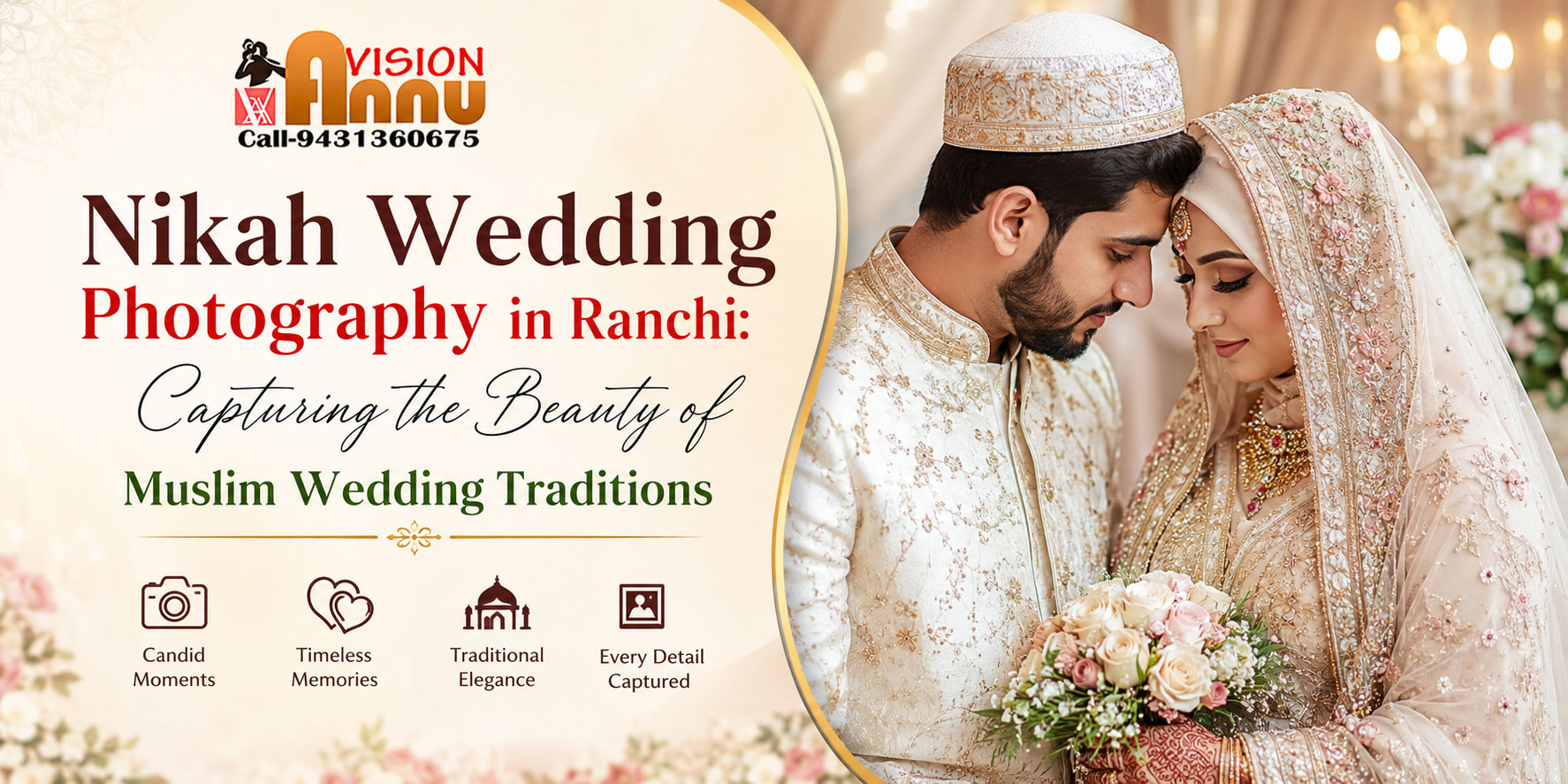
A Nikah has a beauty of its own.
The quiet anticipation before the ceremony. The bride surrounded by her family. The groom arriving with loved ones. The words of acceptance. The signing of the Nikahnama. Dua for the newly married couple. Parents watching with happiness in their eyes. And finally, two families celebrating a beautiful new beginning.
These are not simply photographs to be taken. They are moments that become part of a family’s history.
At AnnuVision, Ranchi, we photograph Muslim weddings with an understanding that a Nikah is first and foremost a meaningful marriage ceremony. Our role is to preserve its emotions, traditions and family moments beautifully while respecting the family’s preferences, privacy and the dignity of the occasion.
A Nikah Story Begins Before the Ceremony
Some of the most beautiful wedding photographs happen before the main ceremony even begins.
At the bride’s home or getting-ready room, there may be a completely different atmosphere—final touches to the bridal attire, jewellery being carefully arranged, mehendi-covered hands, a mother adjusting her daughter’s dupatta, sisters helping with preparations and relatives arriving one after another.
On the groom’s side, there is another story unfolding.
His preparations, conversations with friends, moments with parents and the excitement surrounding his arrival all deserve their own place in the wedding story.
We like to document both sides because years later, couples shouldn’t see only what happened in front of them. Their wedding photographs should also show them the moments they couldn’t personally witness that day.
The Nikah – The Heart of the Wedding
Then comes the moment around which everything else revolves—the Nikah.
The exact arrangement can differ from one family to another. A Nikah may take place at home, in a mosque, at a marriage hall or as part of a larger wedding celebration. Families may also follow different cultural practices alongside the religious ceremony.
This is why we prefer understanding the programme before picking up the camera.
Where will the bride and groom be seated?
Will there be separate arrangements?
Where will the Nikahnama be signed?
Who are the important elders and family members?
Are there moments when the family would prefer photography to be limited?
Knowing these things beforehand allows photographers to capture what matters without constantly interrupting the family.
Because during the Nikah, the ceremony should never have to wait for the camera.
The Moments We Look For During a Nikah
Of course, there are the expected photographs—the bride, groom, ceremony and family portraits.
But a beautiful wedding story is often hidden between those photographs.
A father’s expression.
A mother looking at her daughter.
The bride smiling after the ceremony.
The groom surrounded by his closest friends.
Grandparents giving their blessings.
Children trying to understand everything happening around them.
Relatives meeting after a long time.
A quiet moment between the newly married couple.
These aren’t moments that can always be recreated by saying, “Look here and smile.”
A photographer has to notice them while they’re happening.
That is where candid Nikah photography becomes particularly meaningful.
The Bride – Elegance in Every Detail
Muslim bridal photography can be incredibly graceful.
The bridal outfit, jewellery, mehendi, dupatta and carefully chosen details deserve to be documented, but the bride herself should remain the centre of the photographs.
We prefer portraits that feel elegant and natural rather than turning every photograph into an elaborate pose.
A quiet portrait near a window, the bride looking at her mehendi, a moment with her mother or a genuine laugh with her sisters can sometimes say far more than an extensively staged photograph.
And if the bride or family has particular preferences regarding how and where she is photographed, those preferences should guide the session.
When “Qubool Hai” Becomes a Memory
There are certain moments in life that are remembered long after the words themselves have been spoken.
The acceptance of the marriage is one such moment.
For the photography team, this isn’t a time to manufacture emotion. It is a time to be observant.
The expressions surrounding the couple—the happiness of parents, reactions of siblings and smiles exchanged among relatives—can create some of the strongest photographs of the entire wedding.
The beauty comes from allowing the moment to happen naturally.
The Nikahnama
The signing of the marriage contract is another important part of the visual story of a Nikah.
Rather than taking only one conventional photograph, there are several details that can be documented—the signing itself, hands and expressions, witnesses present and the reactions immediately afterwards.
These photographs help provide context to the wedding album.
When viewed together years later, they don’t simply show how everyone looked.
They help tell what was happening.
Dua, Blessings and the People Who Matter
Wedding photography can easily become too focused on the bride and groom.
But look through an old family wedding album and you’ll often notice something interesting.
The photographs that become most precious with time aren’t necessarily the most glamorous ones.
They are photographs of people.
Parents.
Grandparents.
Brothers and sisters.
Relatives who travelled to attend the wedding.
Friends who were part of that chapter of life.
This is why family photographs remain an important part of our Nikah coverage.
Along with candid moments, we recommend setting aside some time for photographs of the newly married couple with parents, grandparents, siblings and close relatives.
They may feel like simple photographs today.
Twenty years from now, they may be among the most valuable photographs in the album.
Privacy Matters at a Muslim Wedding
A photographer may love a photograph.
That doesn’t automatically mean it belongs on Instagram.
Muslim families can have different preferences regarding privacy, particularly concerning photographs of the bride and female family members.
Some weddings may also have separate areas or arrangements for men and women. Specialist Muslim-wedding photographers commonly plan around such requirements in advance rather than assuming every celebration follows the same format.
We believe this conversation should happen before the wedding.
Tell the photography team if:
- certain people shouldn’t be photographed;
- photography is restricted in a particular area;
- bride-side coverage requires additional privacy;
- particular images shouldn’t be shared publicly;
- you don’t want your wedding used for social media or promotional purposes.
Clear communication lets everyone enjoy the celebration comfortably.
From Nikah to Rukhsati
As the celebration moves forward, the mood changes.
The happiness and excitement of the earlier functions can gradually give way to one of the most emotional parts of a South Asian Muslim wedding—the departure of the bride.
For a photographer, this is another moment where discretion matters.
There is no need to direct emotions.
Parents, siblings, relatives and the bride are experiencing something deeply personal.
Our job is simply to be ready when those moments unfold.
A hand being held.
A final embrace.
A father watching quietly.
A sibling trying to smile through tears.
These photographs often become an emotional closing chapter to the wedding story.
Walima – A New Chapter of the Celebration
The Walima brings another character to the wedding story and is traditionally associated with the groom’s side of the marriage celebration.
The atmosphere may be more relaxed after the emotions and ceremonies surrounding the Nikah.
It is an excellent opportunity for couple portraits, photographs with extended family, guest interactions and wider views of the celebration.
Because many relatives and friends are gathered together, we also recommend planning important group photographs during the Walima rather than leaving them entirely to chance.
Mehendi, Family Celebrations and Other Traditions
Muslim weddings in India can include a range of cultural celebrations around the Nikah.
Mehendi, family gatherings, Baraat, Rukhsati, receptions and Walima may all form part of the wedding depending on the family’s background and preferences. South Asian Muslim wedding traditions vary considerably between families and regions, so they shouldn’t be treated as a single fixed checklist.
That variety is something photography should embrace.
A colourful Mehendi should not look like a quiet Nikah ceremony.
A family gathering should not feel like a formal portrait session.
And an emotional Rukhsati should not be treated like a staged wedding reel.
Each part deserves its own visual character.
Nikah Wedding Videography – Hear the Story, Not Just See It
There are memories that a photograph cannot preserve.
The voices.
The prayers.
A parent’s words.
Family laughter.
The atmosphere in the room.
This is where wedding videography becomes especially meaningful.
Rather than treating a Muslim wedding film simply as a sequence of slow-motion shots, we believe the strongest films preserve the real atmosphere of the wedding.
Natural audio from the occasion, family interactions and important ceremony moments can make the finished video much more personal.
Prefer a Wedding Film Without Music?
This is something couples should be comfortable discussing.
Not every Muslim family has the same preference regarding the use of songs or instrumental music in a wedding film.
If your family prefers a different approach, tell us before editing begins.
The presentation can be discussed around your requirements rather than assuming that every wedding video must follow the same format.
Traditional Photography or Candid Photography?
You don’t necessarily have to choose.
For a Nikah, both have different purposes.
Traditional photography ensures that the ceremony, bride and groom, important relatives and family groups are properly documented.
Candid photography preserves everything happening between those formal photographs.
For most weddings, a thoughtful combination creates a much richer collection.
You get the photograph your grandmother wants framed and the photograph of her smiling when she thinks nobody is watching.
That is the difference between simply covering an event and telling its story.
Planning Nikah Photography in Ranchi
If you’re planning a Muslim wedding in Ranchi, speak with your photographer before the wedding instead of finalising everything only through WhatsApp messages about package prices.
Share your programme.
Explain the family arrangements.
Discuss the venue.
Mention photography restrictions.
Prepare a small list of must-have family groups.
Tell the team which ceremonies are particularly important to you.
And most importantly, tell your photographer what kind of wedding you are actually planning.
An intimate Nikah with close family needs a very different approach from a multi-day wedding with Mehendi, Baraat, Nikah, Rukhsati and Walima.
What Should You Ask Before Hiring a Nikah Photographer?
Don’t ask only:
“What is your package?”
Also ask:
Have you photographed Nikah ceremonies before?
How will you manage separate family arrangements if required?
Can our bridal photographs remain private?
Can you cover both Nikah and Walima?
Will you capture our parents and important relatives properly?
Can we choose the style of our wedding film?
Can you show us a complete wedding rather than only Instagram highlights?
The answers will tell you much more about a photographer than the number of edited pictures promised in a package.
Nikah Wedding Photography in Ranchi with AnnuVision
At AnnuVision, we believe a Muslim wedding deserves photography that is beautiful without losing sight of what the occasion represents.
Our approach combines ceremony documentation, natural candid moments, graceful portraits and family photography, with videography available according to the couple’s requirements.
Coverage can be planned for:
Nikah Ceremony
Bride & Groom Preparations
Mehendi & Family Functions
Baraat
Nikahnama & Important Ceremony Moments
Bride & Groom Portraits
Family Photography
Rukhsati
Reception
Walima
Wedding Videography
Wedding Albums
Every family is different, so the final coverage should be planned around your actual wedding rather than a generic checklist.
Frequently Asked Questions
Can you cover a small family Nikah in Ranchi?
Yes. Wedding photography doesn’t have to mean a large production. Coverage can be discussed according to the size, duration and requirements of your ceremony.
Can you cover Nikah and Walima on different days?
Yes. Multiple functions can be planned according to your dates, venues and required coverage.
Can we request privacy for bridal photographs?
You should communicate privacy and publishing preferences before the event so they can be taken into account while planning coverage.
Can our wedding film be edited without songs?
You can discuss your preferred video and audio approach with the team before editing.
Do you provide both candid and traditional photography?
Yes. The coverage can combine important traditional photographs with natural candid moments.
Can AnnuVision cover Muslim weddings outside Ranchi?
Outstation assignments can be discussed depending on dates, location, availability and travel requirements.
Some Memories Become More Valuable With Time
Your wedding album may be exciting when you receive it.
But its real value appears years later.
One day, you’ll open it and notice more than the clothes, décor and venue.
You’ll notice how young everyone looked.
You’ll remember someone’s laugh.
You’ll see grandparents and relatives gathered together.
You’ll remember your parents’ expressions.
And you’ll return to the day your new journey began.
That is why we photograph weddings.
For Nikah wedding photography and videography in Ranchi, speak with AnnuVision about your ceremony, family preferences and wedding plans.
Categories